
USDC vs USDT: The Ultimate Deep Dive on Reserves, Risks, and Compliance
The Definitive Guide to USDT vs USDC: Deep Analysis, Risks, and Recommendations
Choosing the right stablecoin is crucial for crypto traders, institutional investors, and DeFi users. With the rise of digital finance, two names dominate the market: USDT and USDC. Both promise price stability pegged to the US dollar, but their underlying structures, regulatory adherence, and transparency differ significantly. In this guide, we will explore these differences in depth, providing actionable insights for different user profiles, from retail traders to large institutions.
Understanding the distinction between USDT or USDC goes beyond simple price parity. Traders care about liquidity and network fees, institutions prioritize audited reserves and compliance, while DeFi users evaluate smart contract compatibility and centralization risks.
These nuances determine which stablecoin suits your strategy best. By the end of this article, you will have a clear framework for making informed choices and minimizing risk.

Market perception also matters. Which stablecoin is better can shift depending on current regulatory scrutiny, historical incidents, and network efficiency. For example, Tether has a longer trading history and dominates exchange volumes, whereas USDC emphasizes transparency and institutional trust. Evaluating these factors side by side will clarify where each stablecoin excels or falls short.
USDC Audit vs USDT Transparency: The Core Trust Difference
Trust is the cornerstone of stablecoins. While both USDT and USDC claim full backing by US dollars, their approaches to transparency diverge. Tether primarily publishes attestation reports from third-party firms, offering a snapshot of reserves without full audits. USDC, managed by Circle and the Centre Consortium, provides monthly audited reserves, emphasizing regulatory compliance and institutional confidence. This difference shapes how exchanges, wallets, and traders interact with each coin.
Tether Reserve Composition: A Deep Breakdown of Assets
Tether’s reserves include a mix of cash, US Treasury Bills, commercial paper, and other secured loans. Approximately half of its holdings are cash or cash equivalents, with the rest allocated to short-term commercial paper and less liquid assets. This composition has historically attracted scrutiny, especially during market stress when liquidity becomes critical. Understanding the exact reserve allocation helps users assess the risk of depegging and the reliability of Tether in volatile market conditions.
Commercial paper in Tether’s portfolio can include high-quality corporate debt, but also lower-rated instruments, which introduce counterparty risk. US Treasury Bills provide liquidity and security, while secured loans to affiliated entities may carry additional risk layers. Traders and institutional investors must weigh these factors against their exposure, trading frequency, and the need for instant settlement.
While Tether emphasizes that its assets are sufficient to cover all outstanding tokens, transparency concerns linger due to the reliance on periodic attestations rather than continuous auditing. This distinction sets the stage for comparing it directly with USDC, where fully audited reserves form the backbone of trust.
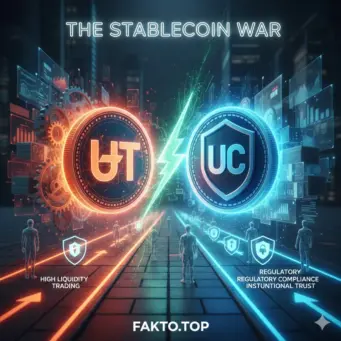
What Backs USDC? Examining Circle’s Fully Audited Reserves
USDC is fully backed by assets held in segregated accounts at regulated financial institutions, with BlackRock and BNY Mellon playing a key role in reserve management. Each USDC token represents one US dollar or an equivalent held in cash and short-term US government securities. Circle provides monthly attestations by independent auditors, ensuring that the supply of USDC matches the underlying reserves. This audit structure contrasts sharply with Tether’s approach, offering institutional investors higher confidence in the coin’s stability and redemption reliability.
The reserve composition prioritizes liquidity and safety, with a large portion in cash and US Treasury Bills, minimizing exposure to commercial paper and riskier assets. This setup allows USDC holders to redeem tokens quickly without concerns over devaluation. The transparency and regulatory alignment also make USDC attractive for corporate treasuries, payment processors, and stablecoin-backed financial products. By ensuring that each token is fully covered and independently verified, USDC establishes a trust framework that supports widespread adoption across exchanges and DeFi protocols.
Regulatory Compliance: SEC and Institutional Adoption (Why USDC is Preferred)
Regulatory adherence is a cornerstone of USDC’s design. Circle and the Centre Consortium maintain strict compliance with the US financial system, including FinCEN, OCC, KYC/AML requirements, and other relevant legislation. SEC oversight and engagement with US regulators provide an added layer of institutional confidence. This compliance ensures that USDC can be integrated into institutional investment products, corporate treasury solutions, and high-volume trading platforms without legal ambiguity.
By contrast, USDT has faced legal challenges and scrutiny regarding the transparency and composition of its reserves. While widely used, these regulatory uncertainties can influence institutions’ willingness to adopt Tether for corporate or high-value applications. USDC’s framework, backed by frequent audits and strong engagement with regulators, positions it as a safer option for entities requiring both security and compliance. These differences directly affect adoption across exchanges, DeFi protocols, and institutional trading desks.
Can USDC Be Frozen by Circle? Understanding the Centralization Risk
One unique aspect of USDC is the centralized authority Circle holds over the token. In certain cases, Circle can freeze accounts or tokens to comply with legal requirements or regulatory directives. While this ensures adherence to anti-money laundering (AML) and sanctions regulations, it introduces centralization risk compared to Tether, which has similar powers but a longer track record of enforcement. Users must understand that holding USDC in centralized wallets carries the potential for intervention under specific circumstances.
For traders and DeFi users, this centralization risk may affect protocol integrations and smart contract usage. Platforms integrating USDC typically account for freezing capabilities, but the theoretical risk of restricted funds remains. Evaluating this risk requires balancing regulatory trust with the desire for decentralization. Ultimately, the ability to freeze USDC contributes to its regulatory credibility while introducing a nuanced layer of operational risk that must be acknowledged by sophisticated users.
Cryptocurrency Market Risks and Blacklisting Authority
This section is crucial because it delves into issues of centralization, security, and the ability to freeze funds, which are primary concerns for users prioritizing decentralization. While often overlooked by casual investors, understanding these mechanisms is vital for serious traders and institutional players managing large stablecoin holdings.
Can USDC Be Frozen by Circle? Understanding the Centralization Risk and Sanctions Compliance
One of the most significant, yet often under-discussed, risks associated with USDC is the potential for Circle to unilaterally blacklist tokens on the blockchain. This feature allows the issuer to instantly freeze funds in compliance with legal mandates, regulatory directives (e.g., AML/KYC), or international sanctions. While this functionality significantly bolsters the confidence of institutional investors and regulators (due to enhanced regulatory compliance), it simultaneously highlights a measure of centralized control that runs counter to the fundamental ideals of decentralized finance.
The article must include a detailed comparison of Circle’s actual exercise of this freezing capability versus similar powers held by Tether. Analyzing how this function impacts the long-term storage and use of USDT vs USDC in DeFi protocols is essential. This power introduces a nuanced layer of operational risk: users must weigh the benefit of regulatory adherence against the risk of potential intervention, especially in high-risk jurisdictions or during political crises.
Tether vs Circle Business Models: How Profit Motives Influence Stablecoin Decisions
To fully grasp the long-term reliability and strategic direction of each stablecoin, it’s necessary to analyze the distinct business models of their respective issuers. Circle (the USDC issuer) is a U.S.-based, regulated entity prioritizing transparency and integration with the traditional financial system. Its profitability stems primarily from the interest earned on its conservative reserve assets, largely composed of US Treasury Bills, and from corporate treasury and payment services. This approach signals a commitment to regulatory stability and conservative asset management, influencing market trust.
Conversely, Tether Limited (the USDT issuer) operates with comparatively less transparency, generating revenue from the interest on its more diversified, and potentially riskier, reserve portfolio. This portfolio has historically included secured loans (secured loans) to affiliated entities, corporate debt, and other investments. Understanding these fundamentally different approaches to generating profit—conservative and regulated versus aggressive and global—is key. It helps users assess the long-term risk of depegging and the strategic viability of each project, providing crucial context for the reserve composition data already presented in the tables.
Best Stablecoin for Trading vs Long-Term Holding
Choosing the right stablecoin depends on your use case. Traders often prioritize liquidity, speed, and network efficiency, while long-term holders emphasize regulatory compliance, transparency, and security. USDT vs USDC presents a clear trade-off between market dominance and institutional trust. USDT dominates global exchange trading volumes, making it ideal for high-frequency trading and arbitrage opportunities. USDC, with fully audited reserves and regulatory adherence, appeals to corporate treasuries, payment providers, and risk-averse investors seeking stability over speculative advantage.
USDT Liquidity: Dominating Global Exchange Trading Volume
Tether’s liquidity is unmatched across major crypto exchanges. It consistently represents the largest stablecoin trading volume, which is critical for traders requiring rapid entry and exit positions. Exchanges from Binance to Huobi and OKX list USDT pairs extensively, covering a wide range of cryptocurrencies. This liquidity ensures minimal slippage for large trades, supporting strategies that depend on speed and predictable execution. Additionally, USDT is available on multiple blockchains, including Ethereum (ERC-20), Tron (TRC-20), and Solana, expanding network flexibility and reducing transaction bottlenecks.
For high-frequency traders, network fees and transaction confirmation speed are decisive. Tether’s presence on the Tron network offers ultra-low fees, making it attractive for rapid arbitrage and DeFi interactions. However, liquidity alone does not eliminate counterparty or depegging risks, which users must consider alongside trading advantages. Understanding both the trading volume and reserve composition of USDT is essential before committing large capital to short-term strategies.
USDC for Institutional Investors: The Compliance-First Approach
USDC appeals to institutions due to its fully audited reserves, transparent reporting, and regulatory alignment. Corporations, funds, and payment providers prefer USDC for treasury management, cross-border settlements, and DeFi participation with reduced legal uncertainty. Circle’s robust compliance framework ensures adherence to FinCEN, OCC, and SEC regulations, while monthly attestations confirm the backing of each token. This structure mitigates counterparty risk, making USDC a preferred choice for organizations managing significant capital under strict regulatory scrutiny.
Institutional adoption is further supported by partnerships with exchanges and custodians that guarantee secure storage and redemption processes. USDC’s compatibility with both Ethereum-based DeFi protocols and centralized finance platforms allows institutions to leverage smart contracts without sacrificing regulatory compliance. For long-term holders and conservative investors, USDC’s structure provides peace of mind, balancing usability with trust and risk management.
Tether vs USD Coin for DeFi: Compatibility and Risk in Protocols
When evaluating DeFi integration, both USDT and USDC are widely supported across major protocols such as Aave, Compound, Curve, and Uniswap. USDT’s extensive liquidity ensures deep market pools and minimal slippage, but centralization concerns and reserve transparency may influence protocol risk assessments. USDC, though slightly less dominant in trading volume, benefits from strong regulatory compliance and fully auditable reserves, which can be critical for institutional users interacting with smart contracts.
Protocol developers often implement risk parameters based on the stablecoin used. For example, platforms may limit leverage or borrowing capacities when USDT is deposited, while USDC might be preferred for higher-value or compliance-sensitive applications. Users must weigh trading efficiency, smart contract security, and reserve transparency to select the optimal stablecoin for DeFi participation. Both coins offer significant advantages, but the choice hinges on the specific risk tolerance and operational requirements of the user.
Network Compatibility and Transaction Costs: Optimizing Fees
Stablecoin efficiency is not only about reserves or liquidity; network choice and transaction fees are critical for cost-conscious users. USDT TRC-20 vs USDC ERC-20 illustrates how blockchain selection affects both speed and expenses. TRC-20 USDT transactions on the Tron network are extremely cheap and confirm in seconds, making them ideal for high-frequency trading and rapid transfers. USDC, primarily on Ethereum as ERC-20, incurs higher gas fees, though Layer 2 solutions like Arbitrum or Optimism can significantly reduce costs while maintaining decentralization and compatibility with DeFi protocols.
For casual transfers, network fees may seem negligible, but for institutional flows or DeFi arbitrage, these costs accumulate quickly. Users must balance the trade-off between cheap, fast networks like Tron and the broader compatibility of Ethereum, especially when engaging in cross-chain protocols. Choosing the right network affects not only fees but also transaction reliability, smart contract integration, and overall operational efficiency.
USDT TRC-20 vs USDC ERC-20: Choosing the Cheapest Network
USDT is available across multiple chains, including Ethereum, Tron, Solana, and Polygon. TRC-20 on Tron provides the lowest fees, often fractions of a cent, and near-instant settlement times. Ethereum-based USDT offers wider DeFi integration but comes with higher gas costs, particularly during network congestion. USDC ERC-20, while costly on mainnet, benefits from Layer 2 adoption, allowing users to access DeFi applications with lower transaction fees while maintaining compliance and transparency.
Polygon and Solana versions of both coins introduce additional options for cost-effective transfers. While USDC on Layer 2 maintains regulatory compliance and audited reserves, USDT on Solana can execute faster transfers with lower costs, though regulatory transparency is comparatively weaker. Traders and institutions must evaluate the operational environment, trading volume, and fee sensitivity before selecting a network for stablecoin use.
| Stablecoin | Cash | US Treasury Bills | Commercial Paper | Other Assets / Loans | Audit Frequency | Transparency Rating |
|---|---|---|---|---|---|---|
| USDT | ~50% | ~20% | ~25% | ~5% | Attestation (periodic) | Medium |
| USDC | ~60% | ~35% | ~5% | Minimal | Monthly Audit | High |
Risk of Depegging and Historical Incidents
Stablecoins carry inherent risks of depegging, and both USDT vs USDC have experienced scrutiny over time. USDT has faced market skepticism due to less transparent reserve compositions, prompting occasional price fluctuations under high-stress conditions. Historical incidents, such as reserve concerns in 2018 and 2019, highlight the potential for short-term instability despite widespread adoption. USDC, while more regulated, is not immune. For example, during the 2023 SVB banking crisis, temporary liquidity pressures raised questions about USDC redemptions, though reserves remained fully backed.
Market volatility, central bank interest rate changes, and sudden large-scale withdrawals can impact peg stability. Fed rate hikes influence the yield on cash equivalents and US Treasury Bills, indirectly affecting both stablecoins. Traders and institutions must monitor these macro factors alongside network performance, as rapid withdrawals or protocol stress can exacerbate depegging risks. Understanding past incidents provides context for proactive risk management and informed stablecoin selection.
How to Redeem USDT for USD: The On-Ramp/Off-Ramp Process
Redemption processes vary between stablecoins. USDT holders can redeem tokens through Tether’s official platform, which involves identity verification (KYC/AML), account approval, and adherence to minimum redemption amounts. Transfers to bank accounts or crypto exchanges are subject to fees and settlement times, and liquidity constraints may delay large transactions. USDC redemption is simpler and more transparent: tokens can be converted back to USD through Circle’s platform with verified accounts, ensuring one-to-one backing at all times.
For both coins, institutional users often leverage custodians or exchange integrations to streamline redemption and reduce operational overhead. Understanding these mechanisms is crucial for traders needing rapid fiat access and for institutional treasury management. Proper planning mitigates delays, ensures compliance, and preserves confidence in stablecoin reliability.
| Metric | USDT | USDC |
|---|---|---|
| Liquidity | Very High (Global Exchange Dominance) | High (Institutional Adoption) |
| Transaction Fees (Avg.) | Low on TRC-20, Higher on ERC-20 | Moderate on ERC-20, Lower on Layer 2 |
| Regulatory Risk | Medium (Legal Scrutiny) | Low (Full Compliance & Audits) |
| Suitability for Trading | Excellent (High-Frequency & Arbitrage) | Good (Institutional Trading & DeFi) |
| Suitability for Long-Term Hold | Moderate (Transparency Concerns) | Excellent (Audited Reserves & Compliance) |
FAQ: Common Questions About USDT and USDC
Is USDT safer than USDC? Safety depends on what you value. USDT dominates trading volume and is very liquid, but its reserve transparency is less clear. USDC is fully audited and regulated, making it generally safer for long-term holding or institutional use.
Which stablecoin has lower gas fees? USDT on TRC-20 (Tron) is by far the cheapest and fastest. USDC on Ethereum mainnet is more expensive, but Layer 2 solutions like Arbitrum or Optimism help reduce costs while keeping your funds compliant and secure.
Have stablecoins ever depegged? Yes, but mostly temporarily. USDT had minor fluctuations during market stress and regulatory scrutiny, while USDC briefly faced questions during the SVB banking crisis. Both generally maintain their $1 peg, but no stablecoin is completely risk-free.
How do USDC and USDT differ in regulatory compliance? USDC is highly compliant with US regulations, audited monthly, and backed by Circle and the Centre Consortium. USDT has faced legal challenges and scrutiny, which may affect institutional adoption or large-scale holdings.
Can USDC be frozen by Circle? Yes, Circle has the power to freeze tokens in special cases to comply with legal requirements or AML regulations. This adds a centralization layer, but also strengthens regulatory trust for institutional users.
Conclusion: Choosing the Right Stablecoin
In the end, USDT or USDC depends on your priorities. If you are a trader looking for liquidity, low fees, and high-frequency arbitrage, USDT on Tron or Solana might be your go-to. If you are an institution, long-term holder, or compliance-conscious DeFi user, USDC offers audited reserves, transparency, and regulatory trust. Both coins integrate well into major exchanges and DeFi protocols, but understanding the trade-offs helps you manage risk and optimize strategy.
Remember, no stablecoin is entirely without risk. Monitor reserve reports, network fees, and market conditions. Use USDT for speed and liquidity, USDC for security and compliance, and consider your personal or institutional needs carefully. By balancing these factors, you can make informed, confident decisions and keep your crypto operations both efficient and safe.
Disclaimer
The content in this article is for informational purposes only.
USDT vs USDC analysis reflects historical data, market trends, and regulatory frameworks as of 2025, but cryptocurrency markets are volatile and conditions can change quickly.
This is not financial advice.
Readers should conduct their own research and consider their risk tolerance before making any trading, investment, or DeFi decisions.