
Travel with Crypto 2026: Hack Your Trips & Skip Bank Fees
Travel with Crypto 2025–2026: How to Hack Your Trip and Skip Bank Fees
In 2025, traveling with a traditional bank card is still a gamble. One fraud trigger, one “unusual location” alert, and your card is frozen while you’re standing at a hotel front desk in Miami or Lisbon. Add the quiet theft of 3% foreign transaction fees on every swipe, and the system feels less like convenience and more like a toll booth. This is exactly why travel with crypto 2025 has shifted from a niche idea to a practical backup plan for US travelers who value control.
Crypto doesn’t replace banks entirely, but it gives you leverage. A stablecoin wallet doesn’t care about borders, weekends, or internal compliance reviews. When cards fail, crypto becomes the pressure valve: you can still book, pay, and move. This blockchain travel guide is not about flexing Web3 ideology. It’s about having a working Plan B that saves money, avoids downtime, and keeps your trip moving even when the legacy system taps out.
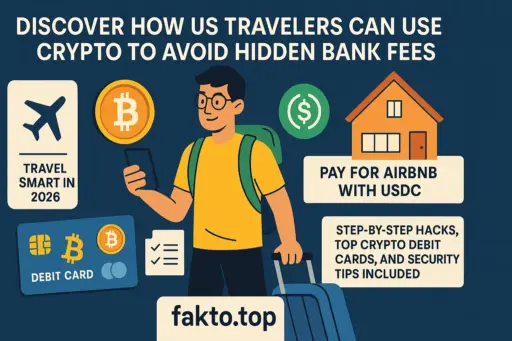
The smartest travelers now treat crypto travel rewards, stablecoins, and on-chain payments as part of their financial carry-on. You may never need it. But when you do, it feels less like a hack and more like foresight.
The Gift Card Loophole: How to Pay for Airbnb with Crypto USDC
If you’re wondering how to pay for Airbnb with crypto USDC, the answer lives in the gray zone between Web3 and legacy platforms. Airbnb doesn’t accept crypto directly, but it happily accepts gift cards. That gap is the loophole. By using crypto-funded vouchers, you bridge on-chain value into a platform that was never built for it.
The cleanest flow in 2025 looks like this. First, move USD into USDC on a low-fee network like Polygon or Base. Second, use a service like Bitrefill to buy an Airbnb gift card with USDC. Most Bitrefill review 2025 breakdowns highlight instant delivery, predictable pricing, and no surprise holds. Third, redeem the voucher and book as usual. From Airbnb’s perspective, it’s just another gift card voucher. From yours, it’s a crypto-native payment rail.
This method shines because it reduces friction. There’s no card swipe, no foreign transaction fee, and often no additional KYC beyond what you already passed on-ramp. For travelers who value speed and privacy, this is one of the most reliable ways to pay for travel with bitcoin alternatives like USDC.
Expert Tip: use fragmented purchasing. Instead of buying one large gift card, split it into smaller vouchers. Legacy platforms are more likely to flag a single high-value redemption than several moderate ones. This simple habit lowers fraud risk and keeps your booking smooth.
Comparison: Crypto Direct Booking vs. Gift Card Stacking
| Platform | Crypto Accepted | Fee Level | Best For |
|---|---|---|---|
| Travala | BTC, ETH, USDT, USDC | Medium | Direct crypto hotel and flight bookings |
| Bitrefill | BTC, ETH, USDC (Polygon) | Low | Gift card vouchers and instant delivery |
| Expedia (via gift cards) | Indirect via crypto-funded cards | Low to Medium | Mainstream inventory with crypto bridge |
| Destinia | BTC | Medium | Crypto-friendly hotel bookings |
The key insight is flexibility. Direct crypto platforms are convenient but limited in inventory. Gift card stacking unlocks the entire legacy travel ecosystem without surrendering control. For US travelers building a resilient setup, this hybrid approach is often the most practical move in the crypto travel ecosystem.
When your bank card fails abroad, this loophole doesn’t. It quietly does the job and lets you keep moving.

Best Crypto Debit Cards for International Travel: Avoiding Foreign Transaction Fees
Traditional banks love to advertise “no annual fee” cards, then quietly skim 3% every time you pay abroad. That hidden tax adds up fast: hotels, rides, food, even checked bag fees. For frequent travelers, this bleed can reach hundreds of dollars per trip. Crypto debit cards flip that equation by routing payments through on-chain balances and using the interbank exchange rate instead of padded bank FX conversions.
The real advantage isn’t hype, it’s mechanics. When you use a crypto card, you’re effectively off-ramping on the go. Your USDC or crypto balance converts at the moment of purchase, often with far lower spreads than legacy banks. For US travelers, this turns crypto from a speculative asset into a practical spending tool. In late 2025 and moving into 2026, this category matured fast, and the differences between cards now matter more than the logos.
The first thing to watch is foreign transaction fees. Some cards advertise “0% FX” but hide costs in conversion spreads. Others are transparent and truly pass through the interbank rate. The second factor is reliability. A travel card that declines randomly is worse than useless. The third is flexibility: can you top up quickly, freeze the card instantly, and off-ramp without waiting days?
Used correctly, crypto debit cards become the frontline tool in your travel setup. Your bank card becomes the backup, not the default. This reversal is subtle, but powerful.
Top 3 US Crypto Cards for International Use
| Card Name | Foreign Transaction Fee | Cashback % | Top Travel Perk |
|---|---|---|---|
| Coinbase Card | 0% | Up to 1% | Direct USDC spending, instant top-ups |
| Crypto.com Ruby / Jade | 0% | Up to 2% | Lounge access, travel perks |
| Gnosis Card (Self-Custody) | 0% | 0% | Non-custodial control, on-chain spending |
The Coinbase Card remains the simplest option for US residents. Its strength is frictionless off-ramping. Load USDC, swipe, done. Coinbase card fees in 2026 are predictable, and the app-level controls make it easy to pause spending instantly if something feels off. It’s not flashy, but it’s reliable, which matters more when you’re crossing borders.
Crypto.com’s Ruby and Jade tiers lean into lifestyle benefits. Lounge access, higher cashback, and a polished app appeal to frequent flyers. The trade-off is complexity. Staking requirements and tier mechanics mean it’s best suited for travelers already comfortable managing multiple balances.
The Gnosis Card represents a different philosophy. It’s a self-custody alternative that never hands control to an exchange. Funds stay in your wallet until the moment of payment. For privacy-focused travelers, this is the cleanest model, though it requires more setup and discipline.
Field Note: always keep a small balance on two cards. One active, one dormant. If a terminal rejects one network, you don’t want to be debugging apps at a checkout counter.
When banks quietly tax every swipe, crypto debit cards act as a pressure release. They don’t eliminate risk, but they dramatically reduce the cost of moving through the world.

The “Invisible Nomad” Setup: Security and Privacy on the Road
Using crypto while traveling changes the threat model. At home, your biggest risk is a phishing link or a bad approval. On the road, it’s physical access, rushed decisions, and border pressure. Crypto security for travelers starts with accepting one rule: convenience is the enemy of safety when you’re moving fast. The goal of the “Invisible Nomad” setup is simple. If something goes wrong, you lose access to a small wallet, not your entire net worth.
The foundation is separation. Your primary holdings stay at home in cold storage. No exceptions. That means no seed phrase in your backpack, no screenshots, no “just in case” notes in cloud storage. Borders are unpredictable environments, and your wallet should assume inspection, device loss, or temporary confiscation as realistic scenarios. A non-custodial wallet on your phone is for spending, not saving.
This is where the decoy wallet strategy comes in. You run two wallets on the same device. One is the visible wallet with a modest balance, used for daily payments and small transfers. The second is protected by a different passcode or duress PIN and holds a slightly larger, but still limited amount. If you’re ever forced to unlock your phone, you reveal the decoy. The real funds remain untouched and unknown.
Hardware wallets deserve special treatment. Traveling with a hardware wallet is fine, but only if it’s empty or holds a negligible amount. Hardware wallet travel safety isn’t about the device, it’s about the data behind it. Your real cold storage device should never cross a border. Instead, think of hardware wallets on the road as signing tools for temporary funds, not vaults.
Two-factor authentication is non-negotiable. App-based 2FA security beats SMS every time, especially when roaming. Before you leave, audit every exchange and service you might touch. Remove phone-number logins, rotate passwords, and confirm recovery emails are accessible without your primary phone. This prep work feels boring, but it prevents catastrophic lockouts in transit.
Operational Rule: assume your phone can be lost or wiped tomorrow. If that thought makes you nervous, your setup is too fragile. A good travel stack survives device failure without panic.
Privacy matters too. Avoid broadcasting balances. Use fresh addresses when possible. Public Wi-Fi is a hostile environment, even in expensive hotels. A simple VPN reduces exposure, but discipline matters more than tools. Don’t sign transactions when distracted. Don’t approve contracts you don’t fully understand. Travel fatigue is real, and attackers count on it.
The Invisible Nomad mindset treats crypto like cash plus memory. You carry what you can afford to lose, and you design your system so loss is inconvenient, not fatal. That’s how you move freely without advertising yourself as a target.
Real-World Payment Flows: How Crypto Actually Works on the Road
The biggest mistake new travelers make is assuming crypto payments work like magic everywhere. They don’t. What works is understanding flows. Crypto is not one tool, it’s a toolbox. In practice, you switch between rails depending on the situation: direct crypto, gift cards, and crypto debit cards. Mastering travel with crypto 2026 is about knowing which rail to use in the moment, not forcing one method everywhere.
Daily spending is the easiest layer. Coffee, rides, groceries, casual dining all belong on a crypto debit card. Swipe, tap, move on. You avoid foreign transaction fees, you get clean conversion, and you don’t expose yourself to on-chain delays. This is where crypto quietly outperforms banks. Nobody at the counter knows or cares what rail you used, and that’s exactly the point.
Bigger expenses require planning. Hotels, flights, long-term rentals, and tours are where gift cards and direct booking platforms shine. When inventory matters more than purity, gift card stacking becomes the default move. You buy vouchers with USDC, redeem them, and book like a normal user. From the platform’s perspective, you’re just another customer. From your perspective, you’ve successfully paid for travel with bitcoin alternatives without touching a bank card.
Direct crypto booking platforms fit a narrower lane. They’re excellent when availability matches your needs and pricing is competitive. When they don’t, you don’t fight the system. You route around it. This flexibility is what separates a functional blockchain travel guide from theoretical advice.
Step-by-Step: Paying for a Hotel Without a Bank Card
- Swap USD to USDC on a low-fee network like Base or Polygon.
- Purchase hotel gift cards in smaller denominations.
- Redeem vouchers gradually, not all at once.
- Complete booking using the platform’s native checkout.
Fragmentation matters more than people think. Legacy platforms monitor behavior, not ideology. A single large redemption from a new account looks risky. Multiple reasonable actions look normal. This isn’t gaming the system, it’s understanding how fraud models work.
Edge cases are where preparation pays off. Late-night arrivals, rural locations, and small vendors are common friction points. Always keep a small amount of local cash as a final fallback. Crypto is powerful, but redundancy is smarter than ideology. The goal is continuity, not proving a point.
Network choice also matters. For payments, speed and predictability beat decentralization purity. Stablecoins on established networks reduce stress. Waiting for confirmations while a line forms behind you is a bad travel experience. Use fast rails for spending, slow rails for storage.
Warning: never troubleshoot finances while exhausted. If something fails, pause, step aside, and switch rails. Rushed decisions are how people approve malicious contracts or send funds to the wrong address.
Crypto works best when it feels boring. When your trip runs smoothly, you forget the system entirely. That’s success. The moment you feel like you’re “doing crypto” too actively, you’re probably overcomplicating it.
A mature crypto travel setup fades into the background. It doesn’t demand attention. It simply works when the legacy system doesn’t.
FAQ: Solving the Practical Crypto Traveler Dilemmas
Most problems with crypto and travel don’t come from technology. They come from uncertainty. Rules feel vague, taxes feel scary, and people assume one wrong move will trigger legal trouble. This section strips that anxiety down to mechanics. These are the questions US travelers actually face when they start using crypto on the road, answered without ideology or fluff.
Is it legal to pay for my vacation with crypto in the US?
Yes. Paying for travel with crypto is legal for US residents. The confusion comes from taxes, not legality. Crypto is treated as property, not currency. That means every time you spend it, you trigger a taxable event. The act of booking a flight or hotel isn’t illegal. Failing to report the transaction correctly is where people get into trouble. As long as you track your cost basis and report gains or losses, you’re operating within the rules.
What is the best crypto for daily payments abroad?
For everyday spending, stability beats speed and hype. USDC is the default choice for most travelers. It avoids volatility, settles quickly, and integrates cleanly with cards and gift card platforms. Comparisons like USDC vs Solana for payments miss the context. Solana is fast, but price swings complicate accounting and budgeting. Stablecoins keep your mental overhead low, which matters when you’re juggling flights, time zones, and logistics.
How do I handle crypto travel taxes in the USA?
Every spend is a disposition. That means you need records. When you pay for a hotel with crypto, you’re effectively selling that crypto at market value. The difference between what you paid for it and what it was worth at spending time is a capital gain or loss. In practice, this gets reported on Form 8949 and summarized on your return. Many travelers simplify life by using stablecoins for spending, where gains are minimal and bookkeeping is cleaner.
Do I need to report crypto if I’m just using gift cards?
Yes. Gift cards don’t hide the transaction. When you buy a voucher with crypto, that crypto spend is still taxable. The voucher itself isn’t taxable, but the conversion into it is. The advantage of gift cards isn’t tax avoidance. It’s access and reliability. Treat them as a bridge, not a loophole.
What happens if my crypto card is declined abroad?
Declines happen. Networks go down. Terminals misbehave. This is why redundancy is part of the crypto travel ecosystem. Keep at least two payment rails active: a crypto debit card and a gift card balance or alternative wallet. When one fails, you switch without drama. The mistake is assuming any single tool is bulletproof.
Will using crypto abroad trigger extra scrutiny?
Not usually. Merchants see a card transaction or a gift card redemption, not your wallet balance. Where scrutiny increases is at on-ramps and off-ramps, not at checkout counters. This is another reason travelers separate storage from spending. Visibility stays low, functionality stays high.
Can I stay compliant without becoming a tax expert?
Yes, if you design for simplicity. Use stablecoins. Minimize swaps. Keep clean records. Export transaction histories periodically instead of trying to reconstruct them months later. Compliance isn’t about perfection. It’s about consistency.
Most crypto travel “problems” dissolve once you stop treating crypto like a magic trick and start treating it like infrastructure. Clear rules, clear records, clear separation of roles. That’s how experienced travelers avoid surprises.
Conclusion: Building Your Crypto Travel Stack for Real-World Use
By the end of 2025, one thing became obvious: crypto travel stopped being a novelty and quietly turned into infrastructure. Moving into 2026, the advantage isn’t knowing every protocol or chasing the newest app. The advantage is having a simple, resilient crypto travel ecosystem that works under pressure. When cards fail, fees stack up, or banks decide to “protect” you at the worst possible moment, your setup carries the load.
The winning strategy isn’t maximalism. It’s stacking three roles that cover each other’s weaknesses. The card handles daily friction. The bridge unlocks legacy platforms. The wallet preserves control. When these pieces are tuned correctly, travel with crypto stops feeling experimental and starts feeling boring in the best possible way.
The Card is your frontline tool. A crypto debit card turns stablecoins into spending power without the quiet tax of foreign transaction fees. It handles groceries, rides, hotels at checkout, and everything that benefits from speed. This is where most people save money without even realizing it. Every swipe that avoids the hidden 3% compounds over a long trip.
The Bridge is how you access the world as it actually exists. Airlines, hotels, and rental platforms weren’t built for crypto, and waiting for them to change is a losing strategy. Gift card stacking fills that gap. It lets you book on mainstream platforms without surrendering control to banks. The bridge isn’t glamorous, but it’s reliable, and reliability is the real luxury when you’re on the move.
The Wallet is your anchor. Non-custodial, minimal, and designed for loss tolerance. Your travel wallet is not your vault. It’s a tool that assumes mistakes, theft, or device failure are possible and plans around them. Real security doesn’t come from paranoia. It comes from separation and limits.
Go-To Checklist for Flying Out Tomorrow
- Move spending funds into USDC on a low-fee network.
- Load a crypto debit card and test it before departure.
- Pre-purchase a small balance of travel gift cards.
- Confirm 2FA access without relying on SMS.
- Leave primary seed phrases and cold storage at home.
- Carry a small cash reserve as a final fallback.
This checklist isn’t theoretical. It’s designed for airports, delays, fatigue, and bad Wi-Fi. It assumes things go wrong, because eventually they do. The purpose of a crypto travel stack isn’t to eliminate friction entirely. It’s to make friction survivable.
The deeper insight is psychological. When you stop depending on a single institution, your decision-making improves. You don’t panic when a card declines. You don’t overpay to avoid inconvenience. You switch rails and keep moving. That sense of optionality is the real payoff.
In 2026, the smartest travelers won’t talk about crypto at all. They’ll just travel. Quietly. Efficiently. On their own terms.