
Mastering Compliant DeFi in the US: 2026 Tactical Guide for Institutional & Advanced Users
Mastering Compliant DeFi in the US: A 2026 Tactical Blueprint
The New Regulatory Standard: Operating Under FIT21 and Form 1099-DA
By January 2026, US DeFi stopped pretending it was an experiment. The sandbox phase is over. What remains is infrastructure — regulated, observable, and increasingly unforgiving to sloppy operators.
The passage of the Financial Innovation and Technology for the 21st Century Act (FIT21), combined with the full rollout of IRS Form 1099-DA, quietly but decisively rewired how decentralized finance functions in the United States. The 2024–2025 transition era was chaotic: half-enforced rules, unclear jurisdiction, and a lot of “we’ll see how this plays out.” In 2026, it has played out.
Under FIT21 Section 102, the regulatory boundary between the CFTC and the SEC is no longer a gray zone. Digital assets that qualify as decentralized commodities fall under CFTC oversight. Tokens with issuer dependence, centralized governance, or profit expectations tied to managerial effort are treated as restricted securities. This distinction sounds academic until you realize it determines whether a protocol is usable, geoblocked, or quietly radioactive for US persons.
Taxation is where theory turns into friction. Form 1099-DA, finalized during the 2025 filing cycle and fully enforced for 2026 reporting, requires gross proceeds and cost-basis disclosure for digital asset transactions facilitated by brokers and broker-adjacent intermediaries. Early assumptions that this applied only to centralized exchanges aged poorly. Updated IRS guidance expanded the definition to include certain DeFi frontends, permissioned liquidity pools, and compliant infrastructure providers.
Translation: on-chain activity is no longer “dark” just because it’s non-custodial. If your stack touches compliant rails, reporting happens whether you like it or not.
This changes the optimization game completely. In 2022, the primary question was yield. In 2024, it was execution speed and MEV leakage. In 2026, the dominant constraint is regulatory survivability. A swap that prints alpha but leaves you with unverifiable cost basis, tainted transaction history, or exposure to sanctioned infrastructure is not clever. It’s deferred damage.
One common misconception is that compliance killed decentralization. It didn’t. What it did was split the ecosystem in two.
On one side, you have fully permissionless protocols: still alive, still useful, but increasingly isolated from institutional liquidity and compliant fiat gateways. On the other side is the emerging “safe-harbor” layer — protocol architectures designed to operate within US regulatory expectations while preserving non-custodial execution and on-chain settlement. This is where serious capital is migrating, slowly and without much noise.
As of late 2025, multiple protocol categories demonstrated workable compliance models. These include decentralized commodity protocols with no issuer-controlled supply, RWA tokenization platforms operating through registered entities, and permissioned liquidity pools that rely on on-chain identity attestations instead of traditional custody. None of this is flashy. All of it works.
The takeaway is uncomfortable but useful. DeFi in the US is no longer about ideology or maximal permissionlessness. It’s about system design. Clean inputs. Clean outputs. And a transaction history that won’t trigger automated AML flags when your 1099-DA hits an auditor’s desk.
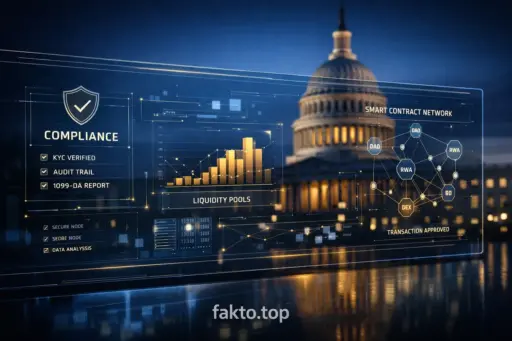
The sections ahead are not a philosophical defense of DeFi. They’re a field manual. The goal isn’t maximum exposure — it’s durable access under US law, without waking up one morning to frozen assets and a very awkward letter.
Selection Framework: Identifying “Safe-Harbor” Protocols in 2026
By 2026, the most expensive mistake in US DeFi isn’t getting rugged. It’s choosing the wrong protocol architecture. Not because it breaks, but because it quietly puts you on the wrong side of the regulatory line.
The post-FIT21 environment forces a simple but uncomfortable question: is this protocol structured as a decentralized commodity network, or does it behave like an unregistered financial product with extra steps? The answer determines whether your interaction is boring and compliant, or exciting right up until it isn’t.
Under FIT21, decentralization is no longer a vibe. It’s a measurable property. Protocols that pass the test tend to share a few traits: no issuer-controlled token emissions, no discretionary governance levers tied to a core team, and no promise—explicit or implied—of profit driven by managerial effort. These systems look dull on the surface. That’s a feature.
In contrast, protocols that rely on foundation-managed treasuries, roadmap-driven token appreciation, or governance that can be “temporarily centralized for upgrades” remain regulatory landmines for US participants. Even if access is technically possible, the compliance surface area is enormous. Think asset seizure vulnerability, not just fines.
A useful mental model in 2026 is this: if a protocol needs a legal memo to explain why it’s not a security, it probably is one. Safe-harbor protocols don’t need clever arguments. Their structure does the talking.
This is where Real World Asset (RWA) tokenization enters the picture. During the transition era, RWAs were dismissed as “CeFi in a DeFi wrapper.” That critique missed the point. In a regulated environment, RWAs became the bridge between on-chain execution and off-chain legal clarity.
Protocols operating under this framework typically tokenize assets like US Treasuries, money market funds, or receivables through registered entities, while settling ownership and yield on-chain. As of late 2025, platforms utilizing this model included implementations built around compliant custodians and transfer agents. They aren’t permissionless in the purist sense, but they are scalable, auditable, and—crucially—boring enough for institutional capital.
The real filter, however, is not whether a protocol is permissioned or permissionless. It’s whether the protocol can produce clean outputs. Can it generate verifiable cost basis? Can it demonstrate that liquidity sources are not sanctioned? Can it survive automated AML screening when its flows touch compliant stablecoin gateways?
If the answer to any of those is “maybe,” that protocol is not a safe harbor. It’s a future headache.
Permissioned vs. Permissionless Liquidity: Where to Allocate?
This is where ideology finally meets accounting. Permissionless liquidity still exists, and for certain strategies it remains unmatched. But for US-based operators managing meaningful size, permissioned pools increasingly serve as the base layer, not the edge case.
Institutional liquidity pools, particularly those tied to RWA vaults, offer predictable yield, transparent counterparties, and on-chain compliance signals. These pools often rely on identity attestations—sometimes issued as non-transferable, soulbound-style compliance tokens—that gate access without taking custody. You keep your keys. The protocol just knows you’re not radioactive.
Permissionless pools, by contrast, are where complexity lives. MEV is higher. Counterparty risk is opaque. And while the yields can still be attractive, the downstream reporting burden is heavier. That doesn’t make them unusable. It makes them situational.
A common strategy in 2026 is layered exposure. Core capital sits in permissioned, compliant pools that produce clean, boring returns. Tactical capital rotates through permissionless environments where the risk is understood, isolated, and sized accordingly. This isn’t capitulation. It’s portfolio construction.
The operators who struggle in this environment are the ones trying to force 2022 behavior into a 2026 system. The ones who adapt treat compliance not as friction, but as another constraint to optimize around. Like gas. Like latency. Like taxes.
And just like those, ignoring it doesn’t make it go away.
Table 1: The 2026 Tactical Risk Matrix (Strategic Comparison)
| Activity / Category | High Legal & Audit Risk (The “Avoid”) | Compliant Safe-Harbor (The “Do”) | Regulatory Reasoning (2026 Context) |
|---|---|---|---|
| Privacy & Mixing | Traditional Mixers (e.g., Tornado Cash, unverified pools) | zk-KYC Protocols (e.g., Midnight, Railgun with “Proof of Innocence”) | Avoid OFAC-sanctioned addresses while maintaining non-custodial privacy |
| Yield Generation | Anonymous “Degen” Farms or algorithmic stables without US audits | Tokenized RWA Vaults (e.g., Ondo, Centrifuge, Securitize) | Assets backed by US Treasuries/Money Markets provide clear legal provenance for IRS audits |
| Governance | Direct voting from personal wallets in “Naked” DAOs (No legal entity) | Wyoming DUNA or Utah DAO LLC wrappers | Limits personal liability; prevents the DAO from being classified as a “General Partnership” |
| Liquidity Provision | Dark, permissionless pools with unknown counterparties | Institutional/Permissioned Pools (e.g., Aave Arc, Morpho Blue with KYC layers) | Minimizes “Taint” risk on your transaction history, crucial for 1099-DA clean reporting |
| Stablecoin Choice | Unregulated or Offshore Algorithmic Stables | Qualified Payment Stablecoins (USDC, PYUSD, GHO) | Ensures “Clean Rails” for fiat exit and 1:1 cost-basis verification |
Practical Execution: Step-by-Step On-Chain Compliance
By 2026, compliance in US DeFi isn’t something you “deal with later.” It’s baked into every transaction. Miss it at the execution level, and no after-the-fact accounting is going to save you.
The core shift is straightforward: regulators don’t need to understand smart contracts—they just need clean, verifiable data. If your on-chain activity produces fragmented, inconsistent, or tainted records, the burden of proof lands squarely on you. In a post-1099-DA environment, that’s a very uncomfortable place to be.
Execution now begins before you even sign a transaction. Wallet setup, RPC routing, tax integration, and MEV configuration are all part of the same decision tree as slippage, gas, and strategy. Treat them as separate tasks, and you’re already losing.
Automated Cost-Basis Tracking for Complex Smart Contracts
The biggest myth that survived the transition era is that DeFi is “too complex” for proper tax reporting. That stopped being true the moment the IRS stopped accepting that excuse.
In 2026, every serious US-based operator runs live cost-basis tracking. Not spreadsheets. Not quarterly exports. Real-time ingestion of on-chain data into tax software that understands swaps, LP positions, partial withdrawals, rebases, and vault accounting.
Protocols don’t need to be custodial to be observable. If your wallet interacts with compliant frontends, permissioned pools, or stablecoin gateways, gross proceeds are being logged. If your tax stack isn’t connected when the transaction happens, you’re reconstructing history later. Reconstruction is where errors — and audits — are born.
Advanced setups use non-custodial tax APIs that monitor wallet activity continuously. The goal isn’t just accuracy. It’s defensibility. When a 1099-DA entry flags a transaction, you want a clean lineage from input asset to output asset, with timestamps, valuations, and protocol context already mapped.
If your response to “how do you track cost basis on-chain?” is “I’ll deal with it at tax time,” you’re operating on borrowed time.
Managing MEV and RPC Settings to Avoid Sanctioned Nodes
MEV used to be a performance problem. In 2026, it’s also a compliance problem.
Routing transactions through random public RPC endpoints increases the probability that your transaction touches sanctioned or non-compliant infrastructure. You don’t control the validator. You don’t control the relay. But you do control how your transaction enters the mempool.
This is why compliant RPC providers matter now. Infrastructure providers operating US-regulated nodes offer predictable routing, auditability, and reduced exposure to OFAC-sanctioned entities. It’s not about censorship. It’s about provenance.
On the MEV side, private transaction routing is no longer just about getting a better fill. Services like US-compliant MEV protection routes reduce sandwich risk while minimizing broadcast to hostile or opaque relays. Less noise. Fewer flags.
The practical rule is boring but effective: if you wouldn’t route institutional trades through an unknown counterparty, don’t route your on-chain transactions through unknown infrastructure. Decentralization does not require negligence.
Taken together, execution hygiene becomes a competitive advantage. Two users can run the same strategy on the same protocol and end up with radically different risk profiles based solely on how they executed. One produces clean, auditable records. The other produces a mess that looks suspicious even when it isn’t.
In 2026, regulators don’t need intent. They just need patterns. Your job is to make sure your patterns look exactly like what they are: compliant participation in protocol-based financial mediation, not something that needs explaining in a conference room.
Advanced Asset Protection: Wyoming DUNA and Utah DAO Entities
By 2026, the most overlooked risk in US DeFi isn’t a protocol rug—it’s personal liability. Holding governance tokens or voting in DAOs without a proper legal structure can be interpreted as participation in a general partnership. Courts have been clear: ownership plus influence equals exposure. Suddenly, your fun voting in a DAO is a potential liability machine.
Wyoming’s DUNA (Decentralized Unincorporated Nonprofit Association) emerged as a response. It allows active DAO participants to wrap their governance involvement in a recognized legal structure without converting it into a traditional corporation. Tokens stay tokens. Voting remains on-chain. Liability, however, is limited.
The advantage is obvious: DUNA recognizes decentralized governance as a feature, not a loophole. Token holders are no longer automatically treated as joint partners. This is crucial if you control 5%+ of governance supply or participate in strategic decision-making. The structure doesn’t reduce your influence—it shields your personal assets.
Utah DAO LLC offers an alternative path. It’s more traditional and recognized by banks and counterparties, but comes with stricter internal rules. Often used when a DAO interacts with off-chain businesses, custodians, or tokenized real-world assets, it sacrifices some flexibility for legal predictability.
The practical takeaway: if you’re just a casual LP, these structures might be overkill. If you’re actively governing, skipping them is reckless. And timing matters—creating a DUNA after a legal challenge is essentially a pricey souvenir; proactive setup is the only real protection.
In mature US DeFi, legal architecture is part of strategy, as important as protocol choice or stablecoin selection. Ignoring it is like trading with no stop-losses and hoping for the best.
Operational Reality Check: Tools, Taxes, and the Cost of Getting It Wrong
By 2026, US DeFi is no longer an “exciting experiment.” It’s a structured system where errors are expensive and obvious. The regulators don’t need to understand your clever strategy—they just need to see messy, unverifiable activity. That’s enough to trigger audits, freezes, and headaches.
Toolstack matters more than ever. Identity layers, tax tracking, wallet hygiene, security audits, and infrastructure choice operate as a single, integrated system. One weak link compromises the rest. Using non-compliant stablecoins, sloppy RPCs, or infinite approvals is no longer just sloppy—it’s a structural vulnerability.
Table 2: The Essential 2026 US DeFi Toolstack (Practical Setup)
| Layer | Recommended Tools | Purpose & 2026 Benefit |
|---|---|---|
| Wallet & Simulation | Rabby Wallet / Safe (Multisig) | Real-time transaction simulation and “Infinite Approval” alerts to prevent drainage and sloppy interactions |
| On-Chain Identity | Quadrata / Coinbase Verifications | Provides “Passport-style” attestations for permissioned DeFi without revealing private data to every dApp |
| Tax & Reporting | Taxbit (Enterprise) / Koinly | Automated, real-time sync for IRS Form 1099-DA; essential for tracking complex DeFi cost-basis |
| Infrastructure (RPC) | Alchemy Supernode / Infura (US) | Routing transactions through US-regulated nodes to ensure compliance with MEV-relay standards |
| Risk Monitoring | Chainalysis Storyline / HAPI | Checking your own “Wallet Score” before interacting with new protocols to avoid AML flags |
| Legal Entity | DUNA / DAO LLC | Legal “wrapping” of your on-chain identity to shield personal assets from protocol-level lawsuits |
Stablecoins now act as compliance rails, not just liquidity vehicles. USDC, PYUSD, or GHO ensure clean entry and exit points, producing verifiable records for 1099-DA reporting. Satisfying, boring, and necessary.
Tax software is no longer a quarterly chore. It’s a continuous monitoring tool. By 2026, automated API integrations track swaps, LP positions, vault interactions, and rebalances in real time. Any deviation is documented, timestamped, and defensible. Reconstructing history after the fact is a liability. Real-time tracking is your insurance.
Security hygiene—managing approvals, private keys, and wallet exposure—has gone from optional paranoia to operational baseline. Infinite approvals or careless dApp interactions are a ticking bomb. Exploits are interpreted as preventable negligence, not “bad luck.”
The most common mistake is trying to do too much at once: mixing permissionless pools, geoblocked protocols, and experimental bridges. Result: a tangled history that is impossible to defend in audits or tax filings.
Sustainable strategies are intentionally boring. Limited protocols. Reusable transaction patterns. Predictable infrastructure. Not glamorous. Not sexy. But reliable. And in 2026, reliability equals alpha.
US DeFi isn’t about circumventing rules—it’s about living in the system and generating returns safely. Those who adapted during the transition era operate calmly. Those clinging to 2022-style freedom wake up to frozen assets or awkward regulator letters.
This guide doesn’t promise maximum upside. It promises durable, compliant access to on-chain financial instruments in a jurisdiction that finally figured out how to handle them. For serious operators, that’s the real edge.
FAQ: 2026 US DeFi Long-Tail Queries
Do I need a 1099-DA for DeFi swaps under $10,000 in 2026?
Short answer: it depends on the asset type. For qualified stablecoins like USDC or PYUSD, swaps under $10,000 may not trigger reporting if the gateway operates under safe-harbor rules. For other digital assets, the IRS expects all-amounts reporting. In practice, this means even small swaps on certain permissioned protocols could generate 1099-DA entries. The safest approach is to connect your wallet to real-time cost-basis tracking tools and assume reporting applies until confirmed otherwise.
Is liquidity providing (LPing) on Uniswap v4 considered a business in the US?
It depends on scale and involvement. Passive LPing with small stakes and minimal governance interaction is generally considered a passive investment. But actively managing positions, arbitraging, or using leverage can tip the IRS into treating it as a trade or business. That designation affects your reporting, deductions, and exposure. Essentially, if your activity looks like operational income generation rather than casual participation, treat it as a business for planning purposes.
How can I legally interact with “geoblocked” protocols from the US?
Bypassing geoblocks via VPNs or foreign IPs creates a “tainted” transaction history that can trigger automated AML flags, KYC mismatches, and 1099-DA complications. The compliant alternative is to wait for an institutional or permissioned version of the same protocol that operates under US jurisdiction, or access the protocol through a registered entity that provides on-chain identity attestation. It’s slower, but it keeps your transaction history defensible.
What’s the best way to manage MEV risks without violating compliance?
In 2026, MEV management is tightly coupled with compliant execution. Using private, US-regulated MEV relays or services like Flashbots Protect US ensures that your transactions avoid sandwiching and other extractive attacks while remaining auditable. Public, unverified relays increase regulatory risk because your transaction may touch sanctioned or non-compliant nodes. The rule: treat MEV mitigation as an operational compliance measure, not just a yield enhancer.
Can I use Real-World Asset (RWA) vaults for yield farming safely?
Yes, but only if the vaults operate under registered entities and maintain transparent ownership and reporting standards. Examples from late 2025–2026 include protocols built on Ondo Finance, Centrifuge, and Securitize frameworks. Anonymous or unregistered “food farms” remain high-risk. The focus should be on verifiable provenance, predictable yield, and audit-ready outputs that feed directly into 1099-DA compliant reporting.
Do I need a Wyoming DUNA or Utah DAO LLC if I hold a small governance position?
Probably not. DUNA and DAO LLC structures primarily protect participants with meaningful governance influence or exposure to strategic decisions. For casual token holders or LPs, the operational overhead may outweigh benefits. The moment your governance position crosses thresholds that attract legal scrutiny—typically 5%+ ownership or voting weight—implementing a legal wrapper becomes prudent.
Which stablecoins are “qualified payment” in 2026?
Stick to fully US-regulated and audited assets: USDC, PYUSD, and GHO are standard. Algorithmic or non-US audited stables remain high-risk for regulatory compliance. Using non-qualified stablecoins for core liquidity can complicate 1099-DA reporting and introduce AML expos
Notice: Legal & Tax Disclaimer
This guide is for informational purposes for the 2026 fiscal year and does not constitute legal or tax advice. DeFi regulations evolve rapidly; always consult a qualified crypto-tax professional or legal counsel before implementing DUNA, DAO LLC, or other structures discussed here. Following the strategies outlined does not guarantee compliance or protect against regulatory enforcement.